Book your free discovery session. Book Now
Two major Google announcements made this week have collectively drawn a line in the sand for anyone who markets a destination, accommodation, tour, or experience online. Google I/O 2026 and Google Marketing Live 2026 - held just days apart - didn't just reveal new features. They revealed a fundamentally different vision of what Google is, what search means, and where travellers will actually go to plan and book their next trip.
If you run digital marketing for a hotel, a tour operator, a DMO, or any travel business that has relied on Google for visibility, this is the most significant shift you will face this decade. Here is what happened, what it means, and what you should be thinking about right now.
Google's annual developer conference has always been a window into where the company is heading. This year, the direction was unmistakable. CEO Sundar Pichai opened by declaring the company is entering what he called the "agentic era" - a world where AI doesn't just retrieve information, it completes tasks on your behalf.
The headline product change is a complete reimagining of Google Search. Google's Head of Search, Liz Reid, described it as "the biggest upgrade to our iconic search box in over 25 years." That is not marketing hyperbole - it is a structural statement about what the company believes search should be.
The new Search experience, powered by Gemini 3.5 Flash (now the default model for AI Mode globally), works like this: users describe what they want in natural, conversational language - attaching images, documents, or even Chrome tabs to their query and Google's AI assembles a response rather than a ranked list of links. The interface drops users into AI-generated interactive experiences complete with custom visualisations and tools.
Perhaps the most significant announcement for marketers is the introduction of Information Agents - persistent, background AI processes that monitor the web around the clock and surface relevant findings without the user needing to ask again. Think of them as a supercharged Google Alerts, but instead of raw links, they synthesise updates and push intelligent, actionable notifications. Planning a trip? Set an agent to monitor pricing and availability for a specific destination and it will notify you when conditions match your criteria.
For travel marketers, the implications are stark. When a traveller's AI agent has already synthesised the best options for a Queenstown winter trip - including pricing, availability, and reviews - and delivered that directly to their phone, your website's ranking in a traditional search result is irrelevant. The agent has already done the work. You were either in that synthesised answer, or you weren't in the consideration set at all.
If Google I/O was the vision, Google Marketing Live (GML) was the commercial model. And for the travel industry specifically, the announcements were seismic.
OTAs are being baked directly into Google's AI trip-planning experience. Booking.com and Expedia - alongside major hotel chains including Marriott and IHG - are being integrated as partners in Google's AI-assisted booking flow. Users will be able to research, compare, and initiate bookings without ever leaving Google. AI Mode will surface options, filter results based on budget, amenities, and reviews, and enable bookings through partner integrations, all within the same conversational interface.
This is not Google becoming an OTA. Google has been explicit that it does not intend to be the merchant of record. But it is Google becoming the interface layer between travellers and the travel industry - and that is arguably more powerful. The OTAs themselves will compete to be the inventory engine behind that interface, while independent operators and smaller accommodation providers risk becoming invisible to it altogether unless they actively seek visibility within the new ecosystem.
On the advertising side, GML introduced a suite of new Gemini-powered ad formats that effectively replace the traditional sponsored search result:
Direct Offers the native deals format Google launched in early 2026 with brands like Chewy, Gap, and L'Oréal is now expanding into travel, with Booking.com and Expedia among the first partners able to surface contextually relevant offers inside AI-assisted trip planning conversations.
The entire Search advertising landscape is being rebuilt from scratch. Keyword bidding still exists, but the creative, the targeting, and the placement logic are all moving to Gemini-driven, intent-based systems.
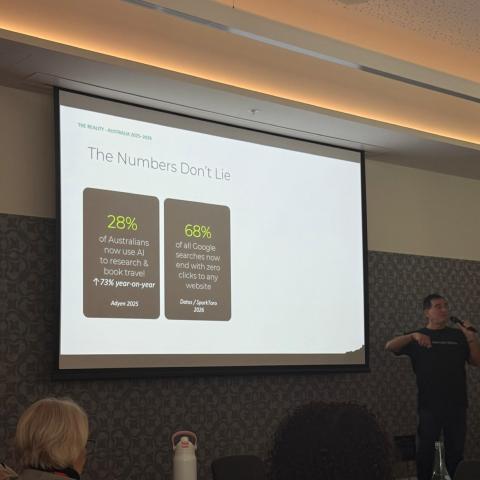
To understand why these announcements matter so urgently, you need to appreciate what has already happened to organic search traffic — before these latest changes even take effect.
The data is sobering:
Travel has been hit especially hard. TripAdvisor's CEO told investors in Q4 2025 that the company was experiencing significant declines in website visitors due to the changing search landscape and the rise of AI Overviews with their CFO adding that free SEO traffic is now expected to generate less than 10% of strategic business gross booking volumes going forward. If one of the world's most authoritative travel websites is losing the SEO battle, independent operators are facing an even steeper climb.
The clicks that used to go to your website are being redistributed — to paid placements, to AI-curated summaries, and increasingly to the OTAs and aggregators with the data infrastructure and advertising budgets to be featured inside AI responses. And with Google's new agentic capabilities rolling out through 2026, this redistribution is set to accelerate dramatically.
The question has fundamentally changed. It used to be: "How do we rank?" Now it is: "How do we get featured inside the AI response - and what does paid visibility look like in this new model?"
These are not the same question, and the tactics that answered the first question do not answer the second. Here is how to think about each dimension:
Getting featured in Google's AI Overviews, AI Mode responses, and agentic recommendations is the new frontier of organic visibility. The strategies that drive this are different from traditional SEO:
The new ad formats announced at Google Marketing Live are not a minor update to existing campaign types. They represent a fundamentally different model of paid search:
The direct booking movement has been a priority for accommodation providers for years — and for good reason. But the latest Google announcements create a new tension.
On one hand, Booking.com, Expedia, and major hotel chains are being privileged as the inventory partners inside Google's AI booking flow. If a traveller uses Google to research and book their next trip (and an increasing number will), the OTAs are positioned as the primary commercial layer.
On the other hand, Google has signalled that it is not trying to replace OTAs — it is trying to sit above them. The practical effect for operators is that OTA listings are becoming table stakes for AI discoverability, while the OTAs themselves pay to be the fulfilment layer.
For destination marketers and tour operators who are not accommodation providers, the integration picture is less clear. Experiences, activities, and tours are not yet as deeply embedded in Google's AI planning flow as flights and hotels — but that gap is closing. Google announced at I/O that it is expanding agentic booking capabilities to local experiences and services, allowing users to specify highly detailed criteria ("a private karaoke room for six, Friday night, serves food late") and have Search find available options and surface booking links. Operators in the experiences and activities space need to be thinking now about their discoverability within these flows.
The website as a primary discovery channel is diminishing. The website as a conversion and credibility asset remains critical.
In a world where travellers arrive already informed — having had their questions answered by AI before they ever visit your site — the job of your website shifts from answering questions to confirming decisions and completing bookings. This has implications for how you structure content, how you handle direct booking incentives, and how you measure success.
AI-referred traffic, when it does arrive, converts at significantly higher rates than traditional organic traffic precisely because visitors are further along in their decision process. Optimising for that conversion moment — with frictionless booking, compelling direct-rate offers, and rich content that builds confidence — becomes more important than ever.
We are at the beginning of this transition, not the end. Google's agentic travel booking capability is still in development, with full flight and hotel booking integration not yet launched. The new ad formats are in testing. Information Agents are rolling out to subscribers first.
But the trajectory is clear and irreversible. The combination of a declining organic channel, a completely rebuilt paid channel, and a new AI intermediation layer between travellers and the travel industry creates a landscape that looks fundamentally different from the one most travel marketing strategies were built for.
The brands and destinations that will emerge from this transition with their discovery reach and commercial performance intact will be the ones that act now — treating AI visibility as a first-class metric, understanding the new paid formats, reviewing their OTA and distribution strategy, and rebuilding their content approach for an AI-mediated world.
This is genuinely new territory, and the implications are still unfolding. If you are a destination marketer, tour operator, or accommodation provider working through what this means for your specific business, we are here to help — and we are actively working through these implications with our client partners right now. The worst thing you can do is wait for the dust to settle. The search landscape is being rebuilt around you in real time.
Have questions about how these changes affect your business? We're working through the specific implications with travel and tourism clients across destination marketing, accommodation, and experiences. Get in touch
Let's Talk