The 5 Pillars of AI Visibility for Travel, Tourism & Accommodation Businesses

By Adrian
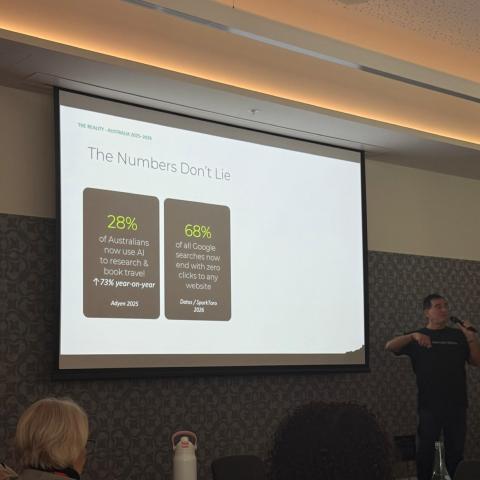
In Part 1 of this series, we covered how dramatically the search landscape has shifted - with 80% of travellers using AI to plan trips, Google losing ground, and fewer than 10% of travel and hotel businesses currently visible in AI search.
Now we get into the framework. Fastrack Digital has identified five pillars that determine whether a travel, tourism or accommodation business appears in AI-generated recommendations. Miss any one of them and you're leaving visibility on the table.

The 5 Pillars of AI Visibility — Fastrack Digital 2026
Pillar 1: Be Found
Before AI can recommend your business, it has to be able to access your website. AI crawlers are not forgiving - they abandon slow sites, struggle with poor URL structures, and skip pages with broken links. Getting the technical foundations right is non-negotiable.
● Page speed under 3 seconds - AI crawlers will abandon slow pages
● Mobile-first design - the majority of AI queries come from mobile devices
● One clear H1 heading per page
● Clean, descriptive URL structure (e.g. /accommodation/beachfront-suite, not /p=1234)
● Booking journey reachable in 3 clicks or fewer from the homepage
● Robots.txt configured to allow AI crawlers - most sites accidentally block them
● No broken links - dead links signal to AI that your site is unmaintained
Pillar 2: Be Understood
Schema markup and structured data are the language AI uses to understand what your business actually is. Without it, AI has to guess - and guesses get you left out of recommendations. For travel, tourism and accommodation businesses, the core schema types are:
● TouristAttraction or LodgingBusiness - depending on your business type
● FAQPage - for your frequently asked questions content
● LocalBusiness - with complete address, hours and contact details
Schema markup is invisible to visitors on your website, but it is essential infrastructure for AI engines to categorise and cite you accurately.
Pillar 3: Be Trusted
Here's a statistic that should change how you think about authority: 85% of pages AI retrieves are never cited. The top position in AI search is cited 58% of the time — but that position is determined by third-party signals, not just by what your own website says about itself.
The trust signals AI engines use to validate travel and tourism recommendations:
● A complete, active Google Business Profile - this is table stakes
● TripAdvisor listing with up-to-date information and recent reviews
● Wikipedia or Wikidata presence, if your business or attraction is notable
● Industry body listings - a industry membership listing, for instance, is a high-authority, topically relevant citation that AI engines recognise
● Press and editorial coverage in tourism publications, travel media and local news
● Consistent NAP data (Name, Address, Phone number) identical across every platform - inconsistency confuses AI engines and erodes trust
Pillar 4: Be Recommended
Understanding how travellers actually phrase their questions to AI is one of the most actionable insights for travel and tourism businesses. The data on what people ask AI reveals four clear patterns:
● 32% include personal attributes - "for families", "for seniors", "for couples"
● 28% mention price or budget - "under $200 per night", "free to visit", "cheap family activities"
● 24.5% ask for "the best" - not just a list, but a direct recommendation
● 16% are location-based - "near me", "in [city]", "30 minutes from the airport"
Generic marketing copy - "a world-class experience in the heart of the city" - does not answer any of these questions. Specific, verifiable, factual content does. Your website needs explicit answers to: "Is this suitable for families?" "What does it cost?" "Is it accessible for people with mobility challenges?" "Exactly how far is it from the CBD?"
Pillar 5: Be Bookable
The final pillar is increasingly important as AI agents - autonomous tools that can search, plan and book on behalf of travellers - become mainstream. Frictionless booking paths are not just good UX; they're a ranking signal for AI.
● Direct booking link clearly visible on the page - not buried in a navigation menu
● Clear pricing, dates and availability - AI needs to see these to recommend you confidently
● Booking journey completable in 3 clicks or fewer
● Mobile checkout that actually works without errors or excessive form fields
What an AI-Ready Page Actually Looks Like
The difference between a page that gets recommended and one that doesn't often comes down to specificity and completeness. Here's the practical comparison:

AI-ready vs not AI-ready — the anatomy of a page that gets recommended
The pattern is clear: vague, generic copy gets ignored. Specific, factual, structured content gets cited. "Australia's most awarded wildlife sanctuary, home to 1,200 native animals" beats "Welcome to our website." "Double rooms from $185 per night including breakfast, 8-minute walk from the train station" beats "centrally located with competitive rates."
|
"65–85% of ChatGPT prompts contain no matching keyword in existing SEO databases. AI is answering questions the old internet wasn't built to answer." |
→ Continue to Part 3: Your 90-Day AI Visibility Action Plan for Travel, Tourism & Accommodation