AI Search for Travel & Accommodation: What's Changed

By Adrian
In the space of just 12 months, AI search has shifted from an emerging curiosity to the dominant force reshaping how travellers plan and book. If you're in travel, tourism or accommodation, the way your business gets discovered has changed permanently - and the numbers make that clear.
This is Part 1 of a three-part series drawn from Fastrack Digital's recent workshop across the country. In this piece we cover what has changed, why it matters, and what the new search landscape looks like. Part 2 introduces the five pillars of AI visibility, and Part 3 delivers a practical 90-day action plan.
The Numbers You Need to Know
Let's start with the data, because the scale of the shift is staggering.
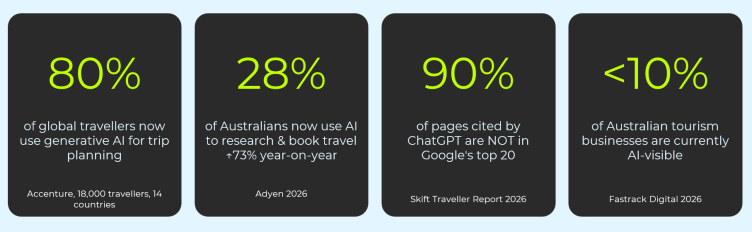
Key AI travel statistics, 2025–2026
● 80% of global travellers now use generative AI for trip planning (Accenture, 18,000 travellers across 14 countries).
● 28% of Australians now use AI to research and book travel - up 73% year-on-year (Adyen 2026).
● 90% of pages cited by ChatGPT are not in Google's top 20 results (Skift Traveller Report 2026).
● Fewer than 10% of Australian tourism businesses are currently AI-visible (Fastrack Digital 2026).
That last statistic is the critical one. The vast majority of travel, tourism and accommodation businesses are invisible to the tools their customers are now using to plan their trips. That's not a crisis - it's a window of opportunity that won't stay open forever.
"If someone asked an AI chatbot for the best places to stay or things to do in your region - would you appear? Most businesses can't answer 'yes' - yet."
Traditional Search Is Losing Ground - Fast
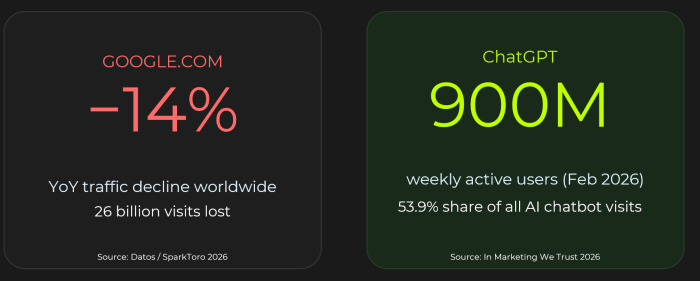
Google traffic has dropped 14% year-on-year worldwide - that's 26 billion visits lost (Datos / SparkToro 2026). At the same time, ChatGPT now has 900 million weekly active users and holds 53.9% share of all AI chatbot visits (In Marketing We Trust 2026).
This doesn't mean Google is dead - far from it. But it does mean that relying solely on Google rankings is no longer enough. Google itself now shows AI Overviews at the top of results, meaning a traveller can get everything they need without clicking through to any website.
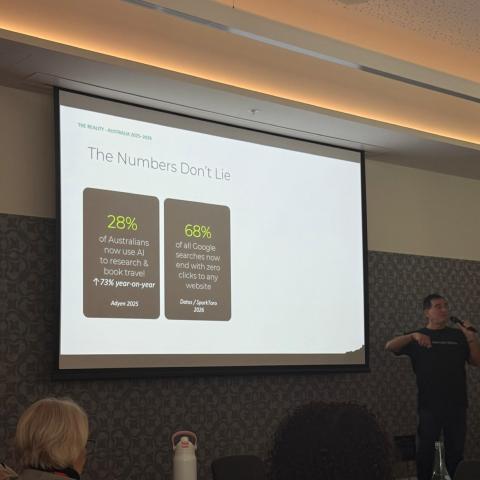
68% of all Google searches now end without a single click to any website - up from 60% in 2024. Your website traffic can drop even when AI is recommending you, unless you're the source being cited in the answer.
The opportunity: travel and tourism businesses optimised for AI get cited in the answer itself. That's the new 'click.
Discovery Hasn't Declined - It's Dispersed
International visitors searching for travel, accommodation and things to do in 2026 are not using one platform. They're using twelve.
Where international visitors are searching in 2026:
|
|
*Source: In Marketing We Trust
If your business only appears on Google, you're missing 11 of these 12 surfaces.
And here's the critical insight: 65–85% of ChatGPT prompts contain no matching keyword in existing SEO databases. AI is answering questions the old internet simply wasn't built to answer - questions like "What's the best boutique hotel in the Hunter Valley for a couples weekend?" or "Which tour operators near Cairns are good for families with young kids?"
Enter GEO: The New Visibility Playbook
This is where Generative Engine Optimisation - GEO - comes in. GEO is the discipline of ensuring your travel, tourism or accommodation business appears in AI-generated answers, not just in ranked search results.
Why both SEO and GEO matter
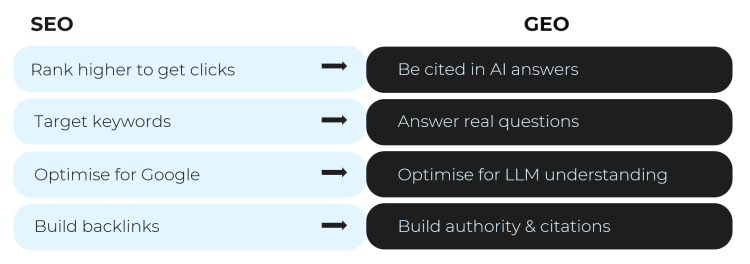
SEO and GEO are complementary, not competing. SEO is about ranking higher on Google to get clicks. GEO is about being cited in AI answers. SEO targets keywords; GEO answers the real questions travellers ask in natural language. SEO optimises for Google's algorithm; GEO optimises for how large language models understand and evaluate your content.
Businesses that master both will dominate the new search landscape. Those that ignore GEO will find themselves increasingly invisible - even as their SEO rankings hold steady.
How AI-visible is your business?
Our free AI Discoverability Audit identifies whether your business is appearing for relevant traveller searches, where competitors are being recommended instead and the areas that need improvement across your website, SEO/GEO, content, reviews and digital authority.