My Predictions for 2026: The Year AI Truly Transforms Travel & Hospitality

By Adrian
As we move into 2026, one thing is clear: this will be the year the hotel and travel industry truly feels the full impact of AI, not just in marketing, but across every part of the business.
AI is no longer a future concept or a side experiment. It is actively reshaping how guests discover, research, compare and decide where to stay often before they ever reach a website or booking engine. In many ways, AI assistants are becoming the new digital concierge, influencing choices earlier and more powerfully than traditional channels ever did.
Discovery Comes Before Booking AND AI Owns Discovery
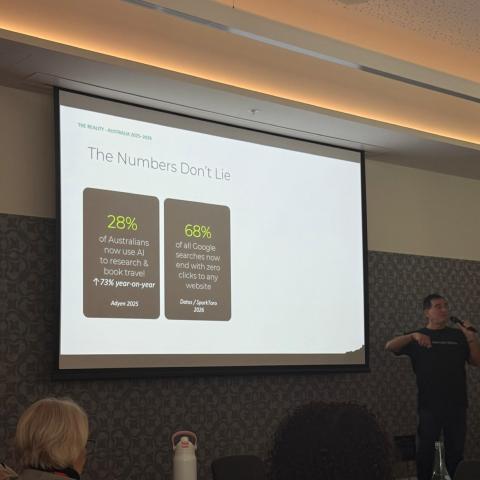
We’re already seeing this shift play out in search. With AI Overviews and AI-generated answers now dominating Google results, brands are being pushed further down the page. The outcome?
Fewer clicks, more competition, and far less reliance on any single channel.
This is forcing a fundamental rethink of how demand is created.
Diversification Is No Longer Optional
In 2026, diversifying demand sources will be critical. Platforms like Meta are becoming even more powerful for inspiration and intent creation, particularly at the top of the funnel. Scroll-stopping creative, short-form video and strong storytelling now play a much bigger role earlier in the booking journey, long before a guest compares rates.
OTAs will, of course, remain important but their influence continues to move further down the funnel. The real value lies in building brand demand, loyalty and direct relationships that reduce dependency over time.
Your Website Is Now Your AI Asset
At the same time, your website has never been more important — but for very different reasons than before.
In 2026, a website must be:
-
Fast and frictionless
-
Persuasive and conversion-focused
-
Structured and written to be AI-readable
-
Powered by AI
Websites can no longer be static brochures. They need to function more like an intelligent digital concierge with AI capabilities similar to ChatGPT allowing guests to ask questions in natural language and instantly surface the most relevant rooms, offers, packages, policies or experiences based on their intent.
Whether a guest is asking “What’s the best room for a family of four?”, “Which package includes spa access?” or “Can I stay with my dog this weekend?”, AI-powered search and assistance removes friction, speeds up decision-making and increases direct bookings.
This capability not only improves conversion, but also ensures your brand is better understood by AI platforms externally helping your business surface inside AI answers and recommendations, not just traditional search results.
SEO isn’t dead BUT it has evolved. GEO (Generative Engine Optimisation) now sits alongside SEO to ensure visibility in an AI-first world.
AI Beyond Marketing: The Real Opportunity
While the technology is moving fast, the fundamentals still matter. Strong websites, compelling book-direct offers, clear value propositions and trust will always be essential.
The real winners in 2026 will be those that embed AI across the entire business not just in marketing:
-
Operations and efficiency
-
Distribution and pricing
-
Data, forecasting and insights
-
Personalisation and guest experience
AI isn’t just a growth lever; it’s becoming an operational advantage.
Creativity Is the New Competitive Weapon
Finally and this is critical - creativity will matter more than ever.
In a world flooded with AI-generated content, brands that stand out visually and emotionally will win attention, trust and, ultimately, direct bookings. Technology may level the playing field, but creativity is what separates the memorable from the forgettable.
Here’s to a successful, innovative and opportunity-filled 2026 for the travel and hospitality industry.
It’s going to be a big year and those who adapt early will reap the rewards.